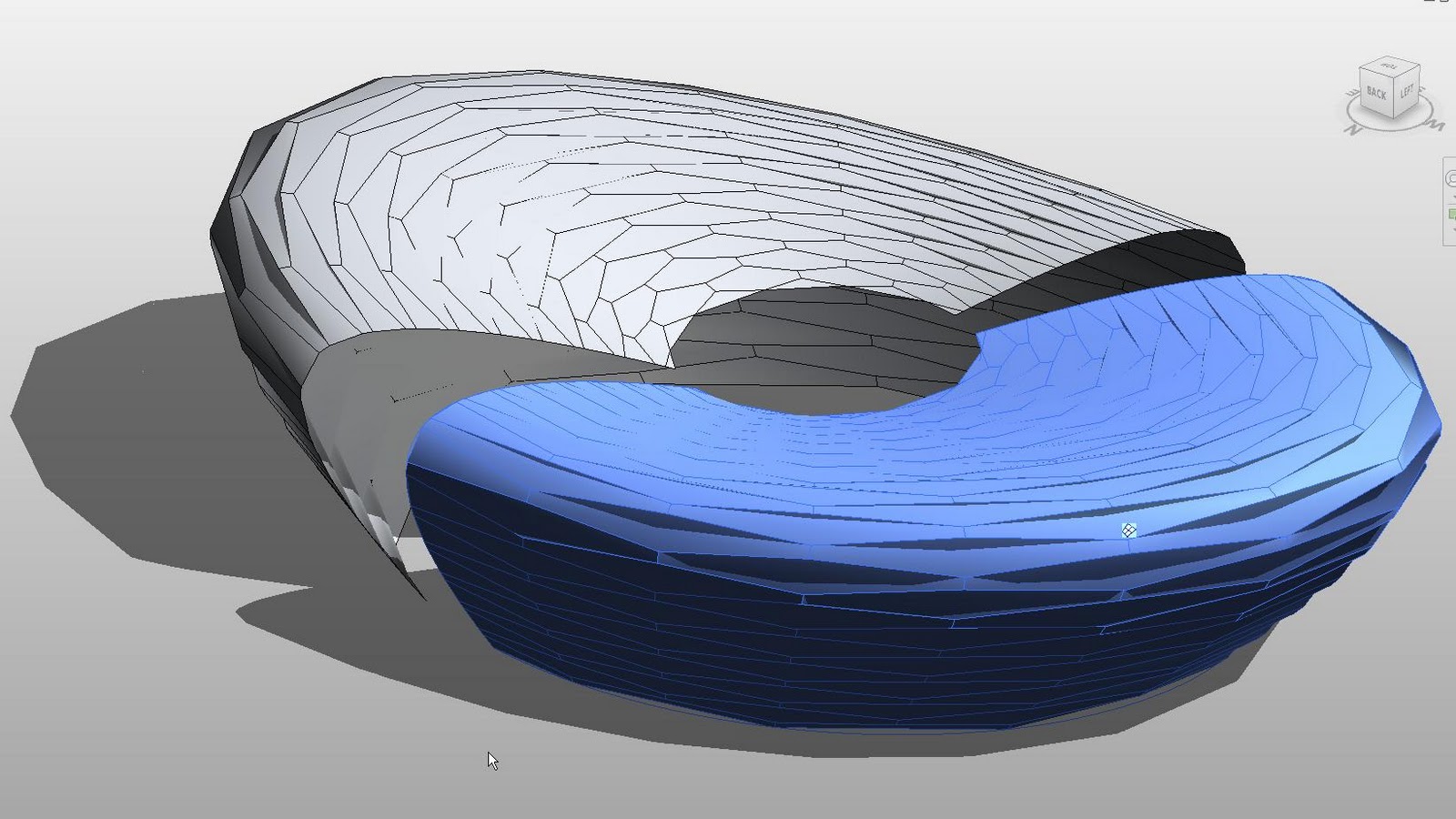
I just love talking with people at AU who want to give me their sob story about some young hot-rod architecture intern who came in and made a bunch of great forms in Rhino, and then sent them into 3dMAX and morphed them, and now they need to recreate these forms in Revit and can't figure out how to do it and waahh waahh...U CAN"T DO THAT IN REVIT.
There's certainly a deeper question of
'Why haven't the tools in the conceptual massing editor been picked up by students' but that's way far beyond the scope of my blog. What i am interested in is seeing how far I can push form generation with the tools i have.
There is a fellow i work with. Very talented young man. He is working in Digital Projects. And just from looking over his shoulder occasionally, i see his process involves a lot of stacking and interlinking of parametric elements. Its like a pyramid that slowly builds upwards. It doesn't seem too different from how i think about form generation in Revit.
With that in mind, I wanted to start looking at how I could build some interesting forms by creating more complex rigs, and then building upon them.
I want to start here:
Ambitious? Maybe. However,
I am not interested in recreating the Bird's Nest. Hell no....though it is a very compelling form, one of these white elephants is enough....I am after the underlying geometry that makes this form possible...which is an oval shaped cone with a saddle shaped top...or at least that's where the affair starts!
So where to begin? How about a pair of ovals like these. I'll link the dimensions of the top oval to the bottom by sticking in a variable to control the incline angle.
To get the saddle shape at the top, I'll have to generate a void form to cut the initial oval-cone. It won't quite be a toroid, but the cutting surface will come close. First i have to develop a curve for the void form to sweep along.
The lengths of this curve are linked to the dimensions of the oval-cone.
Next I'll generate the void form using a bunch of dimensioned reference points placed at the ends of my sweeping curve.

And then i have 2 masses that look like this
change the cutting mass to a void, add an oval to cut a hole in the middle and bang!
With a little adjusting of the parameters, it gets pretty close to the basic mass of the bird's nest.
This is the list of the parameters:
This is the mass file:
SADDLE ENVELOPE RIG.RFA
This ought to be fun to play with until the NDA on the new release expires...
 Paper Dragons
 Entry to Chinatown
 Temple Gate
 Yaowalat Road
 Offering Table
 Knick-Knacks
 Yaowalat Road
 Temple of the Gold Buddha
 Knick-Knack Vendors
 Stewed Pork
 Nice Doggy
 Opera Actors
 Lottery Ticket Vendor